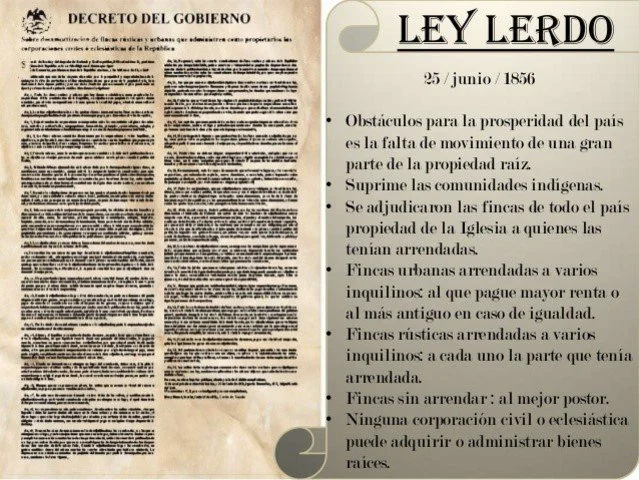
Ley Lerdo
The Ley Lerdo (Lerdo Law), officially known as the Law of Disentailment of Rural and Urban Property Owned by Civil and Ecclesiastical Corporations, was a major liberal reform enacted in Mexico on June 25, 1856. It was named after Miguel Lerdo de Tejada, the Minister of Finance under President Ignacio Comonfort.
Primary Purpose
The central objective of the Ley Lerdo was to stimulate the national economy and create a class of independent small landowners by forcing the sale of vast properties held by corporate entities. The liberal government believed that these large, communally or institutionally held lands were unproductive and that putting them into private hands would foster development and increase tax revenue.
Consequences and Impact
Church Opposition: The Catholic Church vehemently opposed the law, viewing it as a direct attack on its property rights and power. Clergy members threatened those who participated in land purchases with excommunication.
Impact on Indigenous Communities: Although intended to create small farmers, the law severely damaged the economic foundation of indigenous communities by stripping them of their communal lands, or ejidos, which were essential for their subsistence.
Concentration of Land: Due to the high fees and taxes involved, poor indigenous farmers and peasants often could not afford to purchase their land. Instead, wealthy elites, large landowners, and foreign investors were the main beneficiaries, leading to further concentration of land ownership and rural poverty.
Trigger for Civil War: The Ley Lerdo and other Reform Laws were incorporated into the Constitution of 1857, which ultimately triggered the bloody War of Reform (1858–1861).