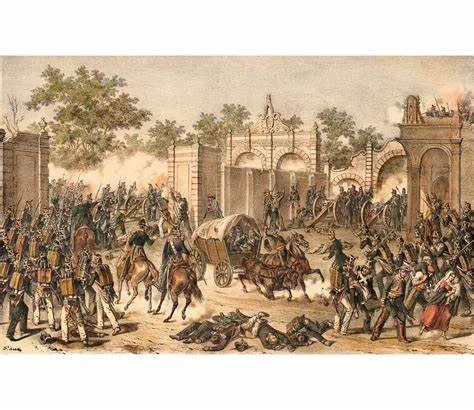
Guerra de Reforma
The Reform War (Spanish: Guerra de Reforma; 1857–1861) was a devastating three-year civil war in Mexico between the liberal and conservative factions. The conflict was a pivotal struggle over two opposing visions for the nation: the liberals sought to create a modern, secular federal republic, while the conservatives aimed to preserve traditional institutions, particularly the power and landholdings of the Catholic Church and the military.
Key Aspects of the War
Causes: The war was a direct result of the liberal-authored Constitution of 1857 and the accompanying "Reform Laws" ( Leyes de Reforma). These measures mandated the sale of most church property, nationalized cemeteries, instituted civil marriage, and restricted the traditional legal privileges (fueros) of the clergy and military. Conservatives viewed these as an existential threat to the traditional social order and their influence, leading to a conservative coup known as the Plan of Tacubaya in December 1857.
Belligerents and Leaders:
Liberals: Led by Benito Juárez, Santos Degollado, and Ignacio Zaragoza, they controlled the coastal regions, including the crucial port of Veracruz, which provided access to customs revenues. They were supported by the United States.
Conservatives: Led by Félix Zuloaga and Miguel Miramón, they initially controlled Mexico City and much of central Mexico. They received support from Spain and, later, from France and the United Kingdom via diplomatic recognition and debt collection efforts.
Outcome: Despite early conservative military victories, the liberals maintained control of Veracruz and eventually accumulated battlefield victories, forcing the conservative forces to surrender in December 1860. Benito Juárez returned to Mexico City on January 11, 1861, consolidating the liberal victory.
Consequences: The war left Mexico's infrastructure and finances in ruins. Juárez's government, facing bankruptcy, suspended payments on foreign debts. This provided a pretext for France, the UK, and Spain to intervene, leading to the Second French Intervention in Mexico and the establishment of the short-lived Second Mexican Empire under Emperor Maximilian I. The liberal victory ultimately cemented the separation of church and state in Mexico, a foundational principle of the modern Mexican republic.